
A bright smile has a way of quietly shaping how confident you feel in almost every social and professional interaction, which is exactly why teeth whitening in Dubai remains one of the most consistently requested treatments across the city’s dental clinics. Yet with drugstore strips, at-home LED kits, whitening toothpaste, and professional in-office treatments all competing for attention, many patients genuinely struggle to understand which option actually delivers safe, lasting results, and which ones simply promise more than they can realistically deliver.
At Premium Cosmetic Laser Center, this is one of the most common conversations we have with new patients, walking through what actually determines a safe, effective whitening outcome, and why a proper dental cleaning Dubai patients complete beforehand matters just as much as the whitening treatment itself. This guide covers everything genuinely worth understanding before choosing how to brighten your smile.
Why Teeth Discolor in the First Place
Understanding why teeth lose their brightness over time makes it considerably easier to understand why certain whitening approaches work better than others. Tooth discoloration generally falls into two broad categories. Extrinsic staining sits on the outer enamel surface, caused by everyday habits like coffee, tea, red wine, and tobacco use, gradually depositing pigment onto the tooth’s surface over months and years. Intrinsic discoloration occurs deeper within the tooth structure itself, sometimes from aging, certain medications taken during tooth development, or internal trauma to a tooth, and generally requires a different, more targeted treatment approach than surface staining alone.
Whitening treatments, whether professional or at-home, work by using bleaching agents, typically hydrogen peroxide or carbamide peroxide, that penetrate the tooth’s microscopic pores and chemically break down the compounds responsible for staining. It is worth being clear on an important point many patients misunderstand. These bleaching agents do not strip, scrape, or dissolve the enamel structure itself. They break apart stain molecules at a chemical level, which is precisely why properly administered whitening, whether in-office or through a dentist-prescribed at-home kit, does not damage healthy tooth enamel when used correctly.
Professional In-Office Whitening: What It Actually Involves
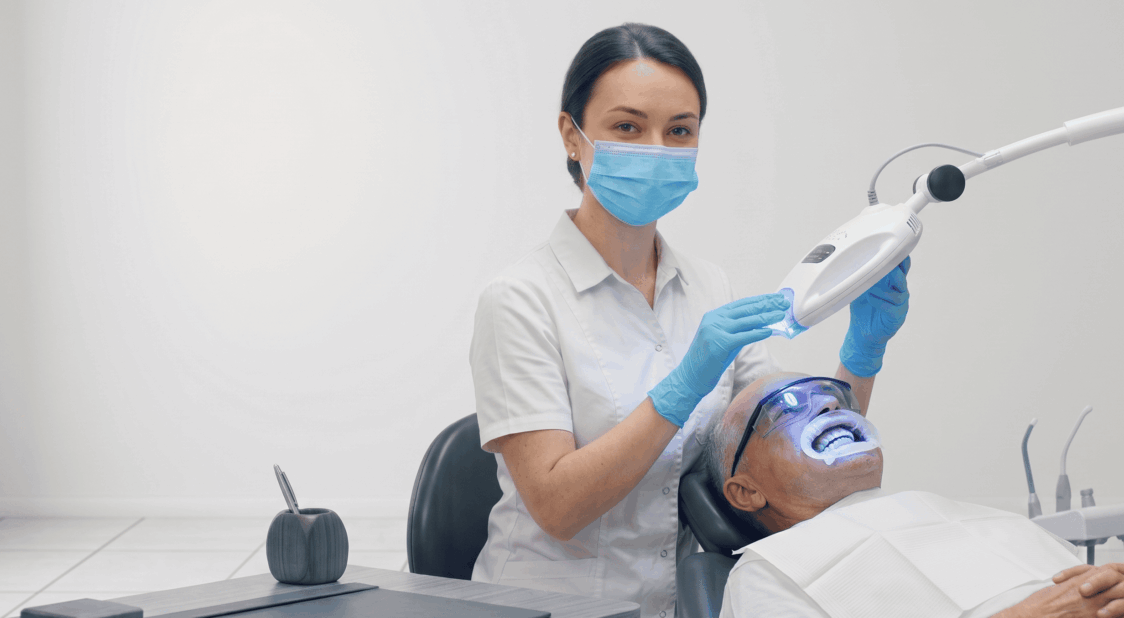
Professional in-office whitening remains the gold standard for anyone wanting the fastest, most dramatic results with the highest level of safety and oversight throughout treatment. The process typically begins with a proper dental examination, since not every tooth and not every patient is automatically a good candidate for bleaching, a point covered in more detail below. Once cleared for treatment, a dental professional applies a protective barrier directly to the gums, shielding the surrounding soft tissue from the whitening gel entirely.
A high-concentration whitening gel, generally in the range of twenty five to forty percent hydrogen peroxide when used alongside proper gum protection, is then carefully applied to the teeth. Many in-office systems use a light-activation technology to accelerate the whitening reaction, typically delivered across a few separate application cycles within a single appointment lasting one to two hours in total.
The results speak to why patients consistently choose this option despite the higher upfront cost compared to at-home alternatives. In-office whitening can brighten teeth by roughly six to twelve shades in a single visit, with some systems capable of achieving results up to eight shades lighter, compared to the considerably more modest one to five shades of improvement typical of at-home strips or kits used consistently over several weeks. Beyond speed and results, professional supervision throughout the session allows continuous monitoring of gum exposure and patient comfort, a meaningful safety advantage that unsupervised at-home products simply cannot replicate.
At-Home Options: Where They Genuinely Fit
At-home whitening is not without genuine merit, and understanding where it fits appropriately helps set the right expectations. Dentist-dispensed custom trays, created from a proper dental impression of your specific teeth, offer a middle ground between in-office treatment and generic drugstore products, using professional-strength carbamide peroxide gel in trays fitted precisely to your own teeth rather than a generic, one-size-fits-all shape. This option typically delivers meaningfully better, more even results than over-the-counter alternatives, since the custom fit ensures the whitening gel makes proper, consistent contact with every tooth surface.
Standard over-the-counter products, drugstore strips, paint-on pens, and generic stock-tray kits, sit at the more accessible end of the spectrum, offering genuine convenience and a lower price point, but lacking the customization and professional-strength formulation of either in-office treatment or dentist-dispensed trays. These products generally use lower peroxide concentrations specifically for unsupervised safety reasons, which is precisely why their results tend to be more modest and require weeks of consistent daily use to achieve even that more limited improvement.
It is worth flagging a genuine safety concern here as well. Unapproved, unproven DIY whitening methods circulating online, particularly highly abrasive approaches using charcoal or similarly harsh scrubbing agents, do not offer the same safe, chemical whitening mechanism as a proper peroxide-based product, and can genuinely damage tooth enamel through physical abrasion rather than safely dissolving stains at a molecular level.
Why a Proper Dental Cleaning Should Always Come First
One of the most important, and most frequently overlooked, steps before any whitening treatment involves a thorough professional cleaning beforehand. Patients with significant built-up tartar or surface plaque will not achieve the even, satisfactory results whitening treatment is capable of producing until this buildup is properly removed first, since the whitening gel needs direct, unobstructed contact with the actual tooth enamel to work effectively.
This is exactly why teeth cleaning Dubai patients complete before a whitening appointment is not simply a nice-to-have addition, but a genuine prerequisite for achieving the best possible outcome. A proper scaling and polishing appointment removes hardened tartar and surface staining, ensuring the whitening gel can penetrate evenly across every tooth surface rather than working inconsistently around areas still covered by plaque or tartar buildup.
Who Is a Good Candidate for Whitening, and Who Is Not
A proper pre-treatment dental examination is a genuine clinical necessity rather than a formality, since not every tooth and not every patient is automatically a good candidate for bleaching treatment. Patients with generally healthy enamel and healthy gum tissue are the strongest candidates for either professional or dentist-supervised at-home whitening. Active tooth decay, gum recession, untreated periodontal disease, or significant existing tooth sensitivity should genuinely be addressed and resolved before any bleaching agent is applied, since peroxide can penetrate compromised enamel or exposed root surfaces and cause genuine discomfort or uneven, unpredictable results.
It is also worth understanding an important limitation regardless of overall oral health. Whitening gel works specifically on natural tooth enamel and does not change the color of existing dental work, including veneers, crowns, or composite bonding. Patients with visible dental work on their front teeth should discuss this directly during their consultation, since whitening surrounding natural teeth without accounting for existing restorations can sometimes result in a visibly mismatched, uneven shade across the smile. For patients whose primary concern involves significant intrinsic discoloration or existing restorations rather than simple surface staining, alternative cosmetic options like porcelain veneers or composite bonding are often better suited to achieving a genuinely even, natural-looking result.
Managing Sensitivity During and After Treatment
Tooth sensitivity remains the most commonly reported side effect of whitening treatment, though recent developments in whitening formulation have meaningfully improved this experience. There has been a growing emphasis across the dental industry on lower-sensitivity whitening formulations that do not sacrifice overall effectiveness, and some recent research has found that pairing hydrogen peroxide bleaching protocols with a follow-up ozone application can meaningfully reduce the sensitivity patients typically experience following treatment.
Patients with a history of gum recession may experience more noticeable discomfort during treatment, given the additional exposure of the tooth’s sensitive root surface in these areas, which is another reason a proper pre-treatment examination matters so much in determining the safest, most comfortable approach for your specific situation. Following treatment, most clinics recommend avoiding particularly hot, cold, or heavily pigmented foods and drinks for a short period, allowing the teeth to settle following the whitening process.
What Realistic Results and Maintenance Actually Look Like
Setting accurate expectations matters considerably for overall satisfaction with any whitening treatment. In-office whitening typically delivers dramatic results within a single one to two hour appointment, often described by patients as feeling immediately noticeable the moment they see their smile afterward. At-home options, whether dentist-dispensed custom trays or over-the-counter products, generally require consistent daily use over one to several weeks to achieve their more gradual, modest degree of improvement.
Regardless of which method is chosen, whitening results are not permanent, since the same everyday habits, coffee, tea, red wine, and smoking, that caused staining originally will gradually reintroduce new surface staining over time. Most patients find that periodic touch-up treatment, whether an occasional in-office session or intermittent use of a dentist-provided at-home tray, helps maintain their preferred level of brightness over the following months and years, alongside consistent oral hygiene and regular professional cleanings.
Why Choosing a Proper Dental Clinic Matters
Given how much genuine clinical judgment is involved, appropriate patient screening, correct concentration selection, proper gum protection, and realistic expectation setting around existing dental work, choosing a properly qualified dental clinic for whitening treatment matters considerably more than simply choosing whichever option appears cheapest or fastest. A rushed or improperly supervised treatment can result in uneven whitening, unnecessary sensitivity, or damage to already compromised enamel or gum tissue, outcomes a proper pre-treatment examination and experienced clinical oversight are specifically designed to prevent.
At Premium Cosmetic Laser Center, every whitening treatment begins with a thorough dental examination and, where needed, a proper professional cleaning beforehand, ensuring your specific teeth and gums are genuinely ready for treatment and that the whitening approach recommended is realistically suited to your particular staining type, oral health, and any existing dental work.
Final Thoughts
Achieving a genuinely bright, healthy smile safely comes down to understanding a few key realities, why teeth discolor in the first place, why professional supervision and proper concentration matter so much for both safety and results, and why a proper dental cleaning beforehand is not optional if you want even, satisfactory whitening across your entire smile. Whether you choose professional in-office treatment for the fastest, most dramatic results or a dentist-supervised at-home option for a more gradual, budget-friendly path, working with a properly qualified provider throughout remains the single most important factor in achieving a result that is both beautiful and genuinely safe for your teeth and gums.
If you are ready to explore your options for teeth whitening in Dubai, the right first step is a proper consultation rather than guessing based on marketing claims alone. At Premium Cosmetic Laser Center, our team can assess your specific teeth, recommend the safest and most effective whitening approach for your situation, and ensure any necessary cleaning is completed first to guarantee the best possible result.
Frequently Asked Questions
- How many shades whiter can professional teeth whitening achieve compared to at-home kits?
Professional in-office whitening can typically brighten teeth by roughly six to twelve shades in a single session, with some systems reaching up to eight shades lighter in one visit. At-home kits and strips generally achieve a more modest one to five shades of improvement, and require consistent daily use over one to several weeks to reach that result.
- Do I need a dental cleaning before getting my teeth whitened?
Yes, this is genuinely important rather than optional. Patients with significant built-up tartar or surface plaque will not achieve even, satisfactory whitening results until this buildup is properly removed first, since the whitening gel needs direct, unobstructed contact with the tooth’s actual enamel surface to work effectively.
- Is teeth whitening safe for everyone?
Not automatically. Patients with healthy enamel and healthy gum tissue are the strongest candidates, while active tooth decay, gum recession, untreated periodontal disease, or significant existing sensitivity should generally be addressed first, since bleaching agents can penetrate compromised enamel or exposed root surfaces and cause discomfort or uneven results. A proper pre-treatment dental examination is essential for every patient regardless of their perceived oral health.
- Will whitening treatment change the color of my crowns or veneers?
No, whitening gel works specifically on natural tooth enamel and does not change the shade of existing dental work such as crowns, veneers, or composite bonding. Patients with visible restorations on their front teeth should discuss this during their consultation, since whitening the surrounding natural teeth without accounting for existing dental work can sometimes create a visibly mismatched shade.
- How long do teeth whitening results actually last?
Whitening results are not permanent, since the same everyday habits that originally caused staining, coffee, tea, red wine, and smoking, will gradually reintroduce new surface staining over time. Most patients maintain their preferred brightness through periodic touch-up treatments, whether occasional in-office sessions or intermittent use of a dentist-provided at-home tray, alongside consistent oral hygiene and regular professional cleanings.
- Why does professional whitening feel safer than at-home strips or DIY methods?
Professional in-office whitening involves continuous supervision by a trained provider, who applies a protective barrier to the gums and monitors comfort and gum exposure throughout the session, something unsupervised at-home products simply cannot replicate. Unproven DIY methods circulating online, particularly abrasive approaches using charcoal or harsh scrubbing agents, can genuinely damage enamel through physical abrasion rather than safely breaking down stains at a chemical level the way a proper peroxide-based product does.
